Loading…
2026 AAHM + AAHN Annual Meeting
Type: Concurrent Session clear filter
arrow_back View All Dates
Friday, June 5
 

9:30am EDT

A1. Grassroots Matters: Beyond the State in East Asian Healthcare
Friday June 5, 2026 9:30am - 11:00am EDT
1. Wayne Soon, Grassroots Politics Matter: Towards a New History of Universal Health Care in Taiwan ([email protected])
2. Po-Hsun Chen, Needling about the ‘One China’: The Policies to Acupuncture Anaesthesia and Trans-Pacific Scientific Acupuncture Research in Cold War Taiwan ([email protected])
3. Eunjeong Ma, Roboticizing healthcare in South Korea: A case of rehabilitation robots ([email protected])

Chair email: [email protected]
Moderators
FF

Fa-Ti Fan

Binghamton University, SUNY
Speakers
avatar for Po-Hsun Chen

Po-Hsun Chen

Assistant Professor, National Yang Ming Chiao Tung University
EM

Eunjeong Ma

Pohang University of Science and Technology

WS

Wayne Soon

University of Minnesota

Friday June 5, 2026 9:30am - 11:00am EDT
Grand Ballroom E Hyatt, Mezzanine Level

9:30am EDT

A2. Bodies, Values, Materiality
Friday June 5, 2026 9:30am - 11:00am EDT
1. Pablo Gómez, Embodied Economies of Freedom: Afro-Caribbean Corporeal Finance in the Seventeenth Century ([email protected])
2. Adam Warren, Ability's Experts: Healers and the Assessment and Diagnosis of Enslaved Litigants in Colonial Lima and Buenos Aires ([email protected])
3. Elizabeth O'Brien, “She answered everything except [where the fetus was]”: Medicine and evangelization in the Santa Clara de Asís Mission, 1777-1833 ([email protected])
4. Mariana Labarca, Medical Opinion at the Real Audiencia: How Healers Inspected, Interpreted, and Valued the Human Body in Eighteenth-Century Chile ([email protected])

Chair email: [email protected]
Moderators
GS

Gabriela Soto LaVeaga

Harvard University

Speakers
ML

Mariana Labarca

University of Santiago

PG

Pablo Gómez

University of Wisconsin, Madison
AW

Adam Warren

University of Washington
Friday June 5, 2026 9:30am - 11:00am EDT
Grand Ballroom F Hyatt, Mezzanine Level

9:30am EDT

A3. Women, Aging, and Chronic Disease
Friday June 5, 2026 9:30am - 11:00am EDT
1. Martha N. Gardner, “Yet to see a decline”: the gendered experience of smoking and lung cancer in American women, 1950s-90s ([email protected])
2. Jesse F. Ballenger, “A Completely Unexplained Feature of Alzheimer’s Disease:” Gender, Senility, and Medical Science in Modern Society ([email protected])
3. Cara Kiernan Fallon, Freedom from Disease and Disability: Healthy Aging in Women from the “New Grandma” to the Zumba Grandma, 1930-2010 ([email protected])

Chair email: [email protected]
Moderators
KS

Kavita Sivaramakrishnan

Columbia University
Speakers
JF

Jesse F. Ballenger

Drexel Univesity

avatar for Martha N. Gardner

Martha N. Gardner

Mass. Coll of Pharm and Health Sciences


CK

Cara Kiernan Fallon

Yale University


Friday June 5, 2026 9:30am - 11:00am EDT
Grand Ballroom G Hyatt, Mezzanine Level

9:30am EDT

A4. Disability and Reproduction in the United States
Friday June 5, 2026 9:30am - 11:00am EDT
1. Miriam Rich, Women’s Reproductive Anxieties and Imaginaries of Disability in the Progressive Era ([email protected])
2. Emma Wathen, “Stop Being a Polio Patient, Be a Mother”: Polio Mothers and Parenting Narratives in the Postwar United States ([email protected])

This panel brings together work from historians who study disability and reproduction in the United States in the nineteenth and twentieth centuries. Histories of reproduction in the United States have often overlooked disability as an analytical category and disabled people as reproductive agents. In line with disability studies scholarship, the collective work of these historians positions disability as both a discourse that has been used to create and defend racial and gender hierarchies, and a lived experience that shaped the reproductive lives of many women in the United States. Examining the portraits, letters, and memoirs of mothers with and without disabilities, this panel explores how American mothers in different eras contended with (and sometimes countered) ableism, whether through fears about congenital disability or assumptions about the maternal fitness of visibly and publicly disabled women. It calls attention to the ways race, gender, and class intersected with disability. Analyzing the active and intentional demonstration of deafness and motherhood in the portrait of Eliza Clerc, Hull demonstrates the imperative role that d/Deaf women like Clerc had in the creation of American Sign Language, the foundation of the American Deaf community, and the advent of deaf education in the nineteenth-century United States. Turning to the Progressive Era, Miriam Rich explores how lay discourse on reproduction encoded complex and contested imaginaries of congenital disability, becoming a site where diverse women worked out questions and anxieties related to racial descent, gendered family structures, environmental determinants of development, and disabled motherhood. Finally, Emma Wathen investigates how, in the wake of the Salk vaccine, American “polio mothers” called attention to the continuing reproductive needs of polio survivors and reinforced their belonging within the status quo of the white, middle-class nuclear family at a time when women with disabilities were widely deemed to be unfit wives and mothers. Foregrounding disability and disabled people, this panel highlights innovative work from emerging scholars in the fields of disability and reproductive history.

Chair email: [email protected]
Moderators
HM

Hilary Marland

University of Warwick
Speakers
MR

Miriam Rich

University of Texas

avatar for Emma Wathen

Emma Wathen

PhD Candidate, University of Wisconsin-Madison
(she/her) I am a PhD candidate pursuing a joint degree in History and History of Science, Medicine, and Technology at the University of Wisconsin-Madison. I study disability and reproduction in the twentieth-century United States, drawing from the fields of disability studies, U.S... Read More →
Friday June 5, 2026 9:30am - 11:00am EDT
Regency Ballroom A Hyatt, Mezzanine Level

9:30am EDT

A5. Reframing the History of 19th century Medicine
Friday June 5, 2026 9:30am - 11:00am EDT
The 19th century in the history of medicine has been viewed as an era of epistemic changes brought about by the advent of the germ theory and the rise of laboratory medicine. While building upon these existing frameworks, this panel makes a historiographical intervention in our understanding of 19th-century medicine by adopting a polycentric approach, expanding the canvas of actors and institutions, ideas and practices as well as bodies and spaces associated with medicine.

This roundtable brings together four speakers who illustrate the dynamism of 19th-century medicine by reorienting our understanding of familiar themes through race medicine, psychiatry, death, and sexuality. Focusing on the use of race in 19th-century medicine, Suman Seth unpacks one of the deepest contradictions of race medicine that was based on differentiating between black and white bodies while simultaneously using black subjects to understand diseases that afflicted white bodies. Sohini Chattopadhyay highlights the significance of death and display, focusing on the prototype of vertical burial pits as a British imperial invention to conceal starvation-related famine deaths and limit expenses while reinforcing divisions of caste and community. Arnav Bhattacharya revises the Eurocentric focus of the Foucauldian argument of the medicalization of sexuality in the 19th century by revealing how disparate sites ranging from Beirut to Bombay influenced the production of sexological knowledge, the practice of sexology, and the diagnosis and treatment of sexual disorders. Through such themes, this roundtable opens up a wider cast of “experts”, social differences, locations, and practices to rethink the assumed characteristics of 19th-century medicine.

Chair email: [email protected]

Learning Outcomes
  1. To reframe our understanding of 19th-century medicine by expanding on the set of actors, practices, institutions, and locations usually associated with major historical developments in that era.
  2. To unpack how historical developments in race medicine, psychiatry, sexual health, as well as the management of the dead, are relevant for medical practice today, as they overlap with core questions of social identity and bioethics in medicine.
  3. The roundtable directly speaks to the issue of the social determinants of medicine as well as the equitable and inclusive representation of health practitioners by highlighting how these were historically relevant concerns even in the 19th century.
Moderators
SS

Suman Seth

Cornell University

Speakers
KM

Karim Malak

Wagner College
SC

Sohini Chattopadhyay

Assistant Professor, Union College


avatar for Arnav Bhattacharya

Arnav Bhattacharya

University of Pennsylvania
Friday June 5, 2026 9:30am - 11:00am EDT
Ellicott Room Hyatt, Floor 2

9:30am EDT

A6. Cross-Cultural Understandings of Madness and the Supernatural
Friday June 5, 2026 9:30am - 11:00am EDT
1. Wendy Turner, Unhealthy Minds: Premodern Understanding of Mental Health and Intellectual Disabilities ([email protected])
2. Stephanie Boyle, Spiritual Medicine: The role of space and place in healing in the Egyptian Delta in the 19th Century ([email protected])
3. Marlis Hinckley, Natural and supernatural healthcare in New Spain ([email protected])

Chair email: [email protected]

The Roosevelt Room is on the 2nd Floor of the Genesee Building.

From the guest elevators on the Lobby Level: Turn left before reaching the main staircase. Continue left through the Genesee Building façade toward the Fitness Center. Take either the elevator or the spiral staircase to the 2nd Floor.

The Roosevelt Room is located above the Citizens Banks Freestanding directional signs will be posted throughout the route.

Moderators
AR

Alisha Rankin

Professor of History, Tufts University
Speakers
avatar for Wendy J Turner

Wendy J Turner

Professor of History, Augusta University
I work on disability history through the lens of law. This includes mental health, intellectual disabilities, medicine, the brain, injury, and impairment. 
MH

Marlis Hinckley

University of Notre Dame

Friday June 5, 2026 9:30am - 11:00am EDT
Roosevelt Room

9:30am EDT

A7. Nurses and the Nursing Profession
Friday June 5, 2026 9:30am - 11:00am EDT
1. Alisa Haushalter, Marie Gill, and Kelly Fulkerson Dikuua The Role of Nursing Theory ThinkTanks in Advancing Nursing Knowledgeand Theory: A historical qualitative study utilizing the Margaret NewmanArchive, 1978-1988
2. Andrej Toth, Building a Modern Nurse: State Policy,Philanthropy, and theProfessionalization of Nursing inInterwar Czechoslovakia (1918–1938)
3. Elizabeth Ahern and Emily Barr, Light, Order, and Authority: VisualizingNursing and Sanitary Science at Scutari
4. Jess Dillard-Wright, Nurses not Nursing: The Profession and Social Movements

The Pearl Room is on the 2nd Floor of the Genesee Building.

From the guest elevators on the Lobby Level: Turn left before reaching the main staircase. Continue left through the Genesee Building façade toward the Fitness Center. Take either the elevator or the spiral staircase to the 2nd Floor.

The Pearl Room is located above the Fitness Center.  Freestanding directional signs will be posted throughout the route.
Moderators
KC

Kim Curry

University of Florida

Speakers
EB

Emily Barr

University at Buffalo School of Nursing

AR

Alisa R. Haushalter

Director, Shelby County Health Department

AT

Andrej Toth

Prague University of Economics and Business

JD

Jess Dillard-Wright

University of Massachusetts Amherst

Friday June 5, 2026 9:30am - 11:00am EDT
Pearl Room

12:30pm EDT

B1. Violence, Children, and the State in the 20th century
Friday June 5, 2026 12:30pm - 2:00pm EDT
1. Deborah B Doroshow, From Classroom to Cop Car: Florida’s Baker Act and the Criminalization of Children’s Behavior ([email protected])
2. Lisa J. Pruitt, Celebrity Surgeon and “Healer of Children”: Dr. Adolf Lorenz in Buffalo and the Power of Publicity, 1923-1924 ([email protected])
3. Geremy D. Lowe, These Are Their Risk Factors: Epidemiology and the Public Health Investigation of the Atlanta Child Murders, 1980-1982 ([email protected])

Chair email: [email protected]
Moderators
AH

Andrew Hogan

Creighton
Speakers
LJ

Lisa J. Pruitt

Middle Tennessee State University

avatar for Deborah Doroshow

Deborah Doroshow

Assistant Professor of Medicine, Icahn School of Medicine at Mount Sinai

avatar for Geremy D. Lowe

Geremy D. Lowe

University of California, San Francisco
Friday June 5, 2026 12:30pm - 2:00pm EDT
Grand Ballroom E Hyatt, Mezzanine Level

12:30pm EDT

B2. Scalpels, Spectacles and Iron Hands: The Early Modern Medical Marketplace at Work
Friday June 5, 2026 12:30pm - 2:00pm EDT
1. Heidi Hausse, Wear and Tear: An Inside Look at a “Used” Sixteenth-Century Prosthetic Hand ([email protected])
2. Samuel Paek, Amputations, Expertise, and the Rise of New Genres of Medical Writing in Sixteenth-Century England ([email protected])
3. Tawrin Baker, The Medicalization of Spectacles in the Seventeenth Century: Assisting and Curing via Mathematical Arts and Crafts ([email protected])

Chair email: [email protected]
Moderators
ER

Evan Ragland

University of Notre Dame

Speakers
HH

Heidi Hausse

Auburn University

SP

Samuel Paek

University of Notre Dame


TB

Tawrin Baker

Independent Scholar

Friday June 5, 2026 12:30pm - 2:00pm EDT
Grand Ballroom F Hyatt, Mezzanine Level

12:30pm EDT

B3. Women, Risk, Public Health, and the Law
Friday June 5, 2026 12:30pm - 2:00pm EDT
1. Elizabeth Sapere, “We Are All Unfit Mothers”: Baby M and the Surrogacy Wars in the 1980s ([email protected])
2. Joanna Federico, External Causes? Conceptualizations of Violence in American Public Health Before the Dickey Amendment (1887 – 1993) ([email protected])
3. Shannon Withycombe, Preserving Her Life: Medical Exceptions in Nineteenth-Century Abortion Laws in the U.S. ([email protected])

Chair email: [email protected]
Moderators
LR

Leslie Reagan

Professor, University of Illinois Urbana-Champaign
Speakers
ES

Elizabeth Sapere

University of Rochester


JF

Joanna Federico

Rutgers University

SW

Shannon Withycombe

University of New Mexico
Friday June 5, 2026 12:30pm - 2:00pm EDT
Grand Ballroom G Hyatt, Mezzanine Level

12:30pm EDT

B4. Imperial Health, Colonial Bodies
Friday June 5, 2026 12:30pm - 2:00pm EDT
1. Kristin Brig-Ortiz, Springs and Cemeteries: Urban Public Health, Water Management, and Burial Ground Surveillance in Colonial South Africa, 1880-1910 ([email protected])
2. Kalman Rotstein, The Fear of Premature Burial and the Campaign for Death Certification in Fin-de-Siècle Britain ([email protected])
3. Ogechukwu Williams, Bodies, Blame, and Birth: Historicizing Maternal Mortality Discourses in Nigeria ([email protected])

Chair email: [email protected]
Moderators
NB

Nandini Bhattacharya

Professor of South Asian History and History of Medicine, University of Houston
Historian. Colonial South Asia, pharmaceuticals, alcohol and narcotics, labour and plantations
Speakers
KB

Kristin Brig-Ortiz

Washington University

KR

Kalman Rotstein

Binghamton University
OW

Ogechukwu Williams

Associate Professor, University at Buffalo, SUNY
Friday June 5, 2026 12:30pm - 2:00pm EDT
Regency Ballroom A Hyatt, Mezzanine Level

12:30pm EDT

B5. Medicine and the Senses in Asia: Regional Stories
Friday June 5, 2026 12:30pm - 2:00pm EDT
While historians of medicine are keenly aware of the importance of sensorial knowledge and practice in healing, most studies have focused on Western societies and the five conventional senses. By discussing medicine and the senses in Asia, this first roundtable, together with a related one submitted separately, aims to reconceptualize what constitutes the senses by exploring a wide range of sensorial conditions and techniques in various Asian healing cultures, from East, South, and Southeast Asia to the Near East. Furthermore, the discussion seeks to shed light on the connection between the senses and culture, gender, and politics in various Asian contexts.

Lisa Brooks discusses the central role of touch in the ontology, epistemology, diagnostics, and treatments of first-millennium Ayurvedic medicine, through which to reveal constructions of gendered interactions and embodied knowledge in premodern South Asian medical sources. Lan Li discusses the sense of ma in premodern Chinese medical and literary sources, a word that denotes a common plant yet encapsulates a multiplicity of sensations related to plant-human relations, including flavor, touch, and pain. Saghar Bozorgi discusses the role of embodied practices in healing mental illness, through oral history narratives of 1960s and 1970s Iran, demonstrating how the senses of non-human creatures could directly impact a human’s mental well-being. Finally, Nicole Barnes discusses the odor of night soil, or “humanure,” in modern China, illustrating how sensitivity to the stench of humanure and its related health concerns became politically mobilized in the Mao era.

Collectively, this roundtable intends to expand our understanding of the senses by bringing key Asian perspectives into the conversation. We also hope that medicine and the senses can be a useful window through which to acquire deeper insights into a given Asian society.

Chair email: [email protected]

Learning Outcomes
  • Develop the capacity for critical thinking about the nature, ends and limits of medicine
  • Understand the dynamic history of medical ideas and practices, their implications for patients and health care providers, and the need for lifelong learning
  • Recognize the dynamic interrelationship between medicine and society through history

Moderators
RR

Ruth Rogaski

Vanderbilt University
Speakers
LL

Lan Li

Johns Hopkins University
SB

Saghar Bozorgi

Princeton University


NB

Nicole Barnes

Duke University

Friday June 5, 2026 12:30pm - 2:00pm EDT
Ellicott Room Hyatt, Floor 2

12:30pm EDT

B6. Environmental Justice and the Historian
Friday June 5, 2026 12:30pm - 2:00pm EDT
This roundtable explores the intersection between environmental justice and histories of health and medicine. The environmental justice movement emerged from protest cultures of the late 1980s, culminating in the 1991 First National People of Color Environmental Leadership Summit in Washington DC, and codified within the EPA in 1994.  While “environmental justice” as an actors’ term is both relatively recent and US-focused, it also serves as an analytic category, enabling an exploration of health, place, and dispossession across broader geographies and temporalities.  By highlighting the intersections of toxic risks and marginalization along economic, ethnic, and racial lines, environmental justice redefined environmentalism to address differential impacts.   Historians of health and medicine have something unique to offer and to learn from close engagement with environmental justice: as a historical moment, as a mode of historical analysis, and as a mode of engaged history.  Merlin Chowkwanyun will speak on how new methodologies and data allow us to broaden our notions of "environmental justice" and to interrogate the legal history that has largely been narrated -- sometimes accurately, sometimes less so -- by EJ activists themselves.   Matt Klingle will take a broader history of environmental justice as the entwined changes to planetary, bodily and social metabolisms from the late 19th century to the present day, with particular focus on diabetes in relation to rural and indigenous healfh.  Jason Chernesky will explore how 1980s healthcare workers, particularly pediatric nurses during the HIV-AIDS crisis, understood environmental inequalities and shaped ecologies of care in marginalized populations in American cities. Rick Mizelle and Harriet Washington use lead poisoning to situate case studies of environmental racism. In Mizelle’s story, EJ becomes an analyst’s category, following lead toxicity from the Civil Rights era to the Flint and Jackson Water Crises.   Washington in turn examines how efforts to address environmental racism in the form of lead poisoning in communities of color, have repeatedly been undermined by the medicalization of diagnoses like pica, which putatively led children of color to ingest lead-paint flakes in heavy-metal-imbued housing. Jeremy Greene will highlight intertwined methods of history as advocacy in communities facing health harms from medical incinerators. 

Chair email: [email protected]

Learning Outcomes
  • Understand the history of environmental justice as inextricably linked to the history of health and medicine
  • Explore the intersection and divergences between

The Roosevelt Room is on the 2nd Floor of the Genesee Building.

From the guest elevators on the Lobby Level: Turn left before reaching the main staircase. Continue left through the Genesee Building façade toward the Fitness Center. Take either the elevator or the spiral staircase to the 2nd Floor.

The Roosevelt Room is located above the Citizens Banks Freestanding directional signs will be posted throughout the route.
Moderators
JG

Jeremy Greene

Johns Hopkins University
Speakers
MC

Merlin Chowkwanyun

Columbia University
MK

Matt Klingle

Bowdoin College

avatar for Jason Chernesky

Jason Chernesky

CLIR Postdocoral Fellow, Food and Drug Administration History Office
RM

Richard Mizelle

University of Houston
HW

Harriet Washington

Columbia University

Friday June 5, 2026 12:30pm - 2:00pm EDT
Roosevelt Room

12:30pm EDT

B7. Nursing in the South
Friday June 5, 2026 12:30pm - 2:00pm EDT
1. Christine Ardalan, Nurses Among the Florida Seminole sand Miccosukee, 1934-1971
2. Charlotte Swint, Bringing Nursing and Medical Care toWest Alabama: A Retrospective Reviewof West Alabama Health
3. Valeria Eadler and Alisa R. Haushalter, Services from the 1970s to 2000s A Century of Public Health Nursing:Archival and Material-Culture Evidence from a Southern State

​The Pearl Room is on the 2nd Floor of the Genesee Building.

From the guest elevators on the Lobby Level: Turn left before reaching the main staircase. Continue left through the Genesee Building façade toward the Fitness Center. Take either the elevator or the spiral staircase to the 2nd Floor.

The Pearl Room is located above the Fitness Center.  Freestanding directional signs will be posted throughout the route.
Moderators
JD

Jess Dillard-Wright

University of Massachusetts Amherst

Speakers
CA

Christine Ardalan

Independent Scholar

avatar for Charlotte Swint

Charlotte Swint

Associate Professor, Frontier Nursing University


avatar for Valeria Eadler

Valeria Eadler

Middle Tennessee State University


AR

Alisa R. Haushalter

Director, Shelby County Health Department

Friday June 5, 2026 12:30pm - 2:00pm EDT
Pearl Room

2:15pm EDT

C1. Gender and Health in the 1960s
Friday June 5, 2026 2:15pm - 3:45pm EDT
1. Andrew Hogan, “Allied Health” in the 1960s: Women’s Professions, Men’s Ambitions ([email protected])
2. Kelly O'Donnell, The Valley of the Dolls and the Cultural History of Medicine: Sex, Drugs, and Health Politics in the 1960s ([email protected])
3. Andrew Pothier, Therapeutic Community Behind Bars: Experiments in Correctional and Community Rehabilitation in the Adirondacks, 1960–1975.” ([email protected])

Chair email: [email protected]
Moderators
avatar for Deborah Doroshow

Deborah Doroshow

Assistant Professor of Medicine, Icahn School of Medicine at Mount Sinai

Speakers
avatar for Andrew Hogan

Andrew Hogan

Creighton University
KO

Kelly O'Donnell

Towson University

AJ

Andrew J. Pothier

University at Buffalo, SUNY

Friday June 5, 2026 2:15pm - 3:45pm EDT
Grand Ballroom E Hyatt, Mezzanine Level

2:15pm EDT

C2. The New Modern Medicine: 'Epidemiological', 'Multifactorial' ,'Risky', 'Evidence-Based', 'Personalized', or 'Postmodern?'
Friday June 5, 2026 2:15pm - 3:45pm EDT
Popular medical history often discusses the rise of ‘modern medicine’ in the 19th or 20th century. Critical medical history problematizes the idea. In his forthcoming academic book The New Modern Medicine: Disease, Evidence, and Epidemiological Medicine (OUP, 2025), Jonathan Fuller revives the idea of modern medicine as a legitimate historical and philosophical problem. This author-meets-critics roundtable will discuss the book’s argument and themes raised by it. The New Modern Medicine argues that scientific medicine made medicine modern. But scientific medicine needs further theorizing. It was once associated with the rise of the experimental laboratory, but this narrow rendering misses the point that scientific medicine is shifting and continues to serve as ground on which new battles for scientific authority are fought, though typically under different terms. Scholarly reflection on the characteristics of scientific medicine can help counteract or at least clarify cultural narratives such as evidence-based medicine and personalized medicine. The New Modern Medicine argues that the new modern scientific medicine since the second world war is epidemiological: many of the concepts and methods of epidemiology became the concepts and methods of clinical medicine. ‘Epidemiological medicine’ weaves together several threads in medical historiography, including contemporary multifactorial conceptions of disease etiology, and the pervasiveness of epidemiological risk in medicine. However, we should also question whether medicine is becoming postmodern, less dominated by the hegemony of mainstream scientific orthodoxy. This roundtable includes historians who have explored some of these themes, especially modern epidemiology and its relationship to medicine. The session will proceed as follows. In speaking slots of approximately 10 min each, the author will summarize the book’s argument, before each of three discussants offers commentary. Then the author will respond before the roundtable discussion enlarges to include the audience for approximately 40 min.

Chair email: [email protected]
 
Learning Outcomes
  • Develop the capacity for critical thinking about the nature, ends and limits of medicine
  • Promote tolerance for ambiguity of theories, the nature of evidence, and the evaluation of appropriate patient care, research, and education
  • Understand the dynamic history of medical ideas and practices, their implications for patients and health care providers, and the need for lifelong learning

Moderators
avatar for Sloane Wesloh

Sloane Wesloh

PhD candidate, History and Philosophy of Science, University of Pittsburgh

Speakers
CP

Christopher Phillips

Carnegie Mellon University

JF

Jonathan Fuller

University of Pittsburgh

EH

Emily Harrison

Wellesley College
RA

Robert Aronowitz

University of Pennsylvania
Friday June 5, 2026 2:15pm - 3:45pm EDT
Grand Ballroom F Hyatt, Mezzanine Level

2:15pm EDT

C3. Between Marginalization and Medicalization
Friday June 5, 2026 2:15pm - 3:45pm EDT
1. Ben Maldonado,  Labor, Sex, and the Construction of “Normal Aging” at the Baltimore Longitudinal Study of Aging, 1950-1980 ([email protected])
2. Maud Jansen, “The Age Factor” in Hip Fracture Care: How Precarity Shaped Therapeutic Change ([email protected])

Chair email: [email protected]
Moderators
CK

Cara Kiernan Fallon

Yale University


Speakers
BM

Ben Maldonado

Harvard University
MJ

Maud Jansen

Harvard University
Friday June 5, 2026 2:15pm - 3:45pm EDT
Grand Ballroom G Hyatt, Mezzanine Level

2:15pm EDT

C4. Institutions of Maternity Care
Friday June 5, 2026 2:15pm - 3:45pm EDT
1. Hilary Marland, ‘Enlarging her capacity as a mother’: Mother and Baby Units and Maternal Mental Illness in Postwar Britain ([email protected])
2. Corey Schultz, Debating Juice: The Controversial History of Fruit Juice in WIC food packages ([email protected])
3. Janet Greenlees, ‘The subject of heated controversy’: maternity care and the unmarried mother in post-World War 1 United States ([email protected])

Chair email: [email protected]
Moderators
ML

Megann Licskai

Yale University
Speakers
CS

Corey Schultz

Graduate Student, University of Rochester


HM

Hilary Marland

University of Warwick
JG

Janet Greenlees

Associate Professor of Health History, Glasgow Caledonian University

Friday June 5, 2026 2:15pm - 3:45pm EDT
Regency Ballroom A Hyatt, Mezzanine Level

2:15pm EDT

C5. Medicine and the Senses in Asia: Cross-Cultural Stories
Friday June 5, 2026 2:15pm - 3:45pm EDT
This roundtable highlights the cross-cultural exchange of sensorial knowledge and practice between different healing cultures within Asia and between Asia and the West. Each participant’s case study reveals a dynamic process of translocal interplay in forming emergent understandings about the senses in relation to the body, conditioned by commercial interests, religious aspirations, and colonial influences. Yan Liu examines how transregional exchange of aromatics from West, South, and Southeast Asia—like saffron, camphor, and frankincense—shaped the production of olfactory knowledge and its relation to medical practice among Chinese physicians in the medieval period. Claire Cooper investigates how “mummy medicine,” as knowledge and commodity, was translated from early modern Dutch pharmacopeia into Japanese medical treatises, and the multisensorial ethical concerns that emerged in Japan from the idea of consuming the dead. Genie Yoo explores the role of the body and the senses in Islamicate understandings of spirit possession and exorcism in early modern and modern Indonesia, with an emphasis on the medical and magical potency of Quranic verses in their recited, written, and edible forms. Finally, Ling Ma illuminates how Euro-American missionary surgeons based in China at the turn of the twentieth century relied on touch to establish trademark “modern” methods in diagnosing and treating the birthing body of Chinese women. Paying attention to both local and transregional dynamics influenced by the circulation of commodities, ideas, and people, this second roundtable, together with a related one submitted separately, invites participants and attendees to rethink the role of the senses in medicine and society across regions and time periods, while bringing a diversity of Asian perspectives into the conversation.

Chair email: [email protected]

Learning Outcomes
  • Develop the capacity for critical thinking about the nature, ends and limits of medicine
  • Understand the dynamic history of medical ideas and practices, their implications for patients and health care providers, and the need for lifelong learning
  • Recognize the dynamic interrelationship between medicine and society through history

Moderators
PG

Pablo Gómez

University of Wisconsin, Madison
Speakers
GY

Genie Yoo

University at Buffalo, SUNY

YL

Yan Liu

University at Buffalo, SUNY

avatar for Claire Cooper

Claire Cooper

Assistant Professor, Eastern Kentucky University
I am a historian of material and intellectual exchange in Japan from roughly 1600 to 1900, with a particular focus on the trading and consumption of medicine and medicinal substances. 
LM

Ling Ma

State University of New York, Geneseo

Friday June 5, 2026 2:15pm - 3:45pm EDT
Ellicott Room Hyatt, Floor 2

2:15pm EDT

C6. COVID-Studies: The History of Medicine Meets Disaster
Friday June 5, 2026 2:15pm - 3:45pm EDT
While many people, politicians, and policymakers seek to “move on” from COVID-19, scientists and survivors are still coming to know, and struggling to understand, its features and impacts. Origin stories double as foreign policy battles; denialism gives way to agnotology. But the social worlds that made the COVID-19 pandemic into the most resounding disaster of our times are well known to us; they are inheritances, and they have historical structure. Although it no longer drives our headlines, we suggest that we are still researching and writing from inside the disaster; not formally acknowledged as a pandemic anymore by global health officials, but nevertheless a disaster in its toll on life, health, economy, safety, and justice. In fact, COVID is a nested disaster, a deadly and debilitating virus, tucked inside of an infodemic, woven through traumatically inadequate health systems in the United States and around the world. COVID is also a compound disaster, entangled with climatic disasters of land, air, and sea, and grinding against the tragedies of migration, war, and political dysfunction. These modes of analysis take COVID and its lessons out of the museum of past disasters, where powerful people and institutions want it to remain, and put it right back into the middle of our lives, where it belongs for now, and surely for a very long time to come. The pandemic also quickly changed the ways many people lived their daily lives--a sense of history helps as we watch the disastrous become quotidian. 

This roundtable brings together the history of medicine and disaster studies, connecting scholars eager to discuss the archival, methodological, and political problems posed by researching the the history of pandemics from inside a pandemic. While uniform in their commitments to historical knowledge as a necessary tool for survival in a disaster, the participants come from different scholarly traditions, with differential commitments and strategies for public engagement. The roundtable will allow these many perspectives to be heard, and audience members will actively participate in the conversation. Participants will include George Aumoithe, Jih-Fei Cheng, Gregg Gonsalves, Monica Green, Scott Gabriel Knowles, Jacob Steere-Williams, and Jacqueline Wernimont.

Chair email: [email protected]

Learning Outcomes
This roundtable will provide participants practical skills in understanding historiographical trends in the history of medicine and in disaster studies. Additionally it will allow participants to see history as an unfolding set of conflicts, resolved through the deployment of political power, expertise, and dispoute. Participants will appreciate the ways that medicine and society co-structure each other as dynamic spaces of human action. Lastly, participants will hear under-represented voices in history, and see the importance of full inclusivity in the formation of historical archives.

The Roosevelt Room is on the 2nd Floor of the Genesee Building.

From the guest elevators on the Lobby Level: Turn left before reaching the main staircase. Continue left through the Genesee Building façade toward the Fitness Center. Take either the elevator or the spiral staircase to the 2nd Floor.

The Roosevelt Room is located above the Citizens Banks Freestanding directional signs will be posted throughout the route.
Moderators
SK

Scott Knowles

Northeastern University

Speakers
JS

Jacob Steere-Williams

Professor, Department of History, College of Charleston

GA

george aumoithe

Assistant Professor of History and of African and African American Studies, Harvard University
JW

Jacqueline Wernimont

Dartmouth College

JC

Jih-Fei Cheng

Associate Professor, Scripps College


MH

Monica H. Green

2026 AAHM Garrison Lecturer, Independent Scholar
GG

Gregg Gonsalves

Research Scholar in Law, Lecturer in Law, & Co-Director, Global Health Justice Partnership, Yale University
Friday June 5, 2026 2:15pm - 3:45pm EDT
Roosevelt Room

2:15pm EDT

C7. Teaching Nursing History
Friday June 5, 2026 2:15pm - 3:45pm EDT
1. Darlla Thompson, From Camp to Clinic: Teaching Nursing History Through the Legacy of Pauline Bray Fletcher and Simulation-Based Learning
2. Sally Ellis Fletcher, Integrating History into a Time Limited Guest Lecture
3. Amber P. Williams, Understanding our roots: engaging students in the history of nursing
4. Cassondra Burks, Using AI in Course Development for a Nursing History Course

​The Pearl Room is on the 2nd Floor of the Genesee Building.

From the guest elevators on the Lobby Level: Turn left before reaching the main staircase. Continue left through the Genesee Building façade toward the Fitness Center. Take either the elevator or the spiral staircase to the 2nd Floor.

The Pearl Room is located above the Fitness Center.  Freestanding directional signs will be posted throughout the route.
Moderators
MG

Mary Gibson

Associate Professor Emerita, University of Virginia
Speakers
SE

Sally Ellis Fletcher

University of Missouri-Kansas City School of Nursing and Health Studies

avatar for Cassie Burks

Cassie Burks

University of Tennessee at Martin
avatar for Darlla Thompson, DNP, MPH, FNP-BC, PMHNP-BC

Darlla Thompson, DNP, MPH, FNP-BC, PMHNP-BC

Assistant Professor, Troy University
The Nursing Museum of Alabama website serves as an educational and community‑focused digital hub dedicated to preserving and promoting the history, contributions, and impact of nursing in Alabama. The site highlights nursing heritage, educational resources, public outreach initiatives... Read More →
Friday June 5, 2026 2:15pm - 3:45pm EDT
Pearl Room

4:00pm EDT

D1. Flash Talks
Friday June 5, 2026 4:00pm - 5:15pm EDT

1. Justin Barr, Look into My Heart: Cardioscopes, Technology, and Heart Surgery in the 20th Century ([email protected])
2. Ken Sullivan, Tracing the Disability Discourse: Women Healers and Premodern European Disability History from the 4th to 17th Century ([email protected])
3. Adia Cullors, "Black Powder, Bio-Revolt, and the Black Atlantic": Gunpowder and Medical Resistance 1700 -1899  ([email protected])
4. Yemok Jeon, Translating Ginseng: Korean Efforts to Prove the Medicinal Effects of Ginseng through Biomedical Language, 1960s–1970s ([email protected])

Chair email: [email protected]
Moderators
NT

Nancy Tomes

Professor of History, Stony Brook University
Speakers
JB

Justin Barr

Ochsner Clinic

KS

Ken Sullivan

Louisiana State University


AC

Adia Cullors

New York University

YJ

Yemok Jeon

PhD Student, Johns Hopkins University
Friday June 5, 2026 4:00pm - 5:15pm EDT
Grand Ballroom E Hyatt, Mezzanine Level

4:00pm EDT

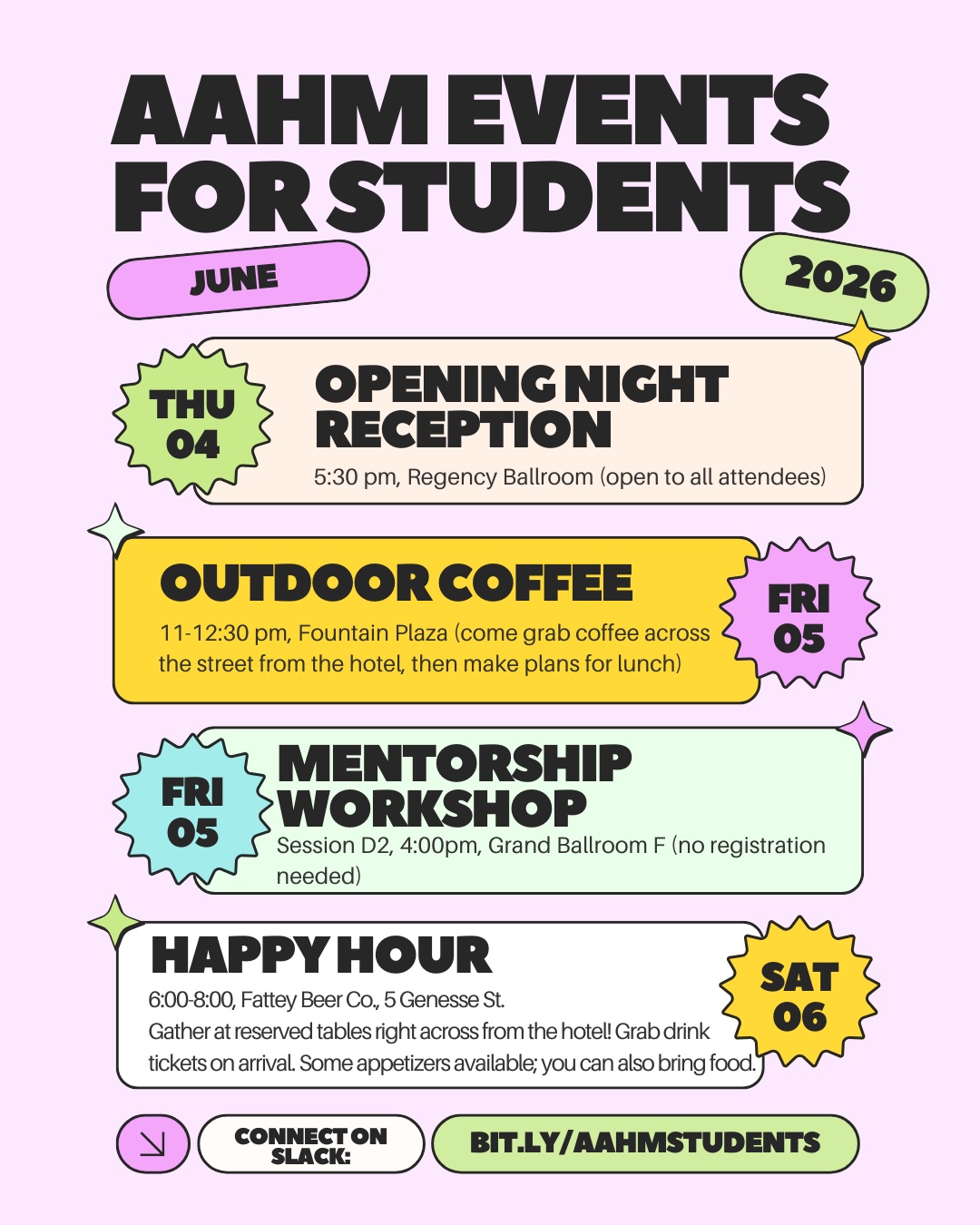
D2. Mentorship Workshop: Insights From Faculty, Staff, and Postdocs for Students
Friday June 5, 2026 4:00pm - 5:15pm EDT
The AAHM Student Affairs Committee is happy to be reprising our mentorship workshop for the third year. In this workshop, students and more established professionals in academia, libraries, archives, and museums will break into small groups to chat about the job search, funding, publishing, and more. We will have prompts on hand, but please bring questions of your own. This is a great opportunity to hear candid advice from people who have been where you are, and to kickstart new relationships in the process.

Chair email: [email protected]

Speakers
JH

Jessica Hester

Johns Hopkins University

Friday June 5, 2026 4:00pm - 5:15pm EDT
Grand Ballroom F Hyatt, Mezzanine Level

4:00pm EDT

D3. Collaborative Histories of Institutionalization: Archives, Activism, and Access
Friday June 5, 2026 4:00pm - 5:15pm EDT
This proposed roundtable presents several new, innovative projects in the public history of institutionalization. Participants come from across disciplines including History, Media Studies, Library and Information Science, American Studies, and Women, Gender, and Sexuality Studies. We will highlight the importance and complexity of collaboration–with disabled activists and community members, undergraduates, other scholars, and even corporations–in bringing hidden histories to light. Caitlin Angelone will highlight the newly opened archive at Elwyn, an active service organization wrestling with preserving both its own dark history and its modern reputation. Brenda Brueggemann will present on three years of work with UConn undergraduates to preserve and interpret the archives and history of the Mansfield Training School. Ashten Vassar-Cain and Jess Petrazzuoli-Gallagher will share their current efforts to expand access to materials from Speaking For Ourselves, one of the nation’s first self-advocacy organizations, as part of a community-controlled digitization project. Finally, Heather Cassano and Chelsea Chamberlain (also Chair), will discuss the Institution Cemetery Project, an in-progress website that maps the locations and memorialization statuses of institution cemeteries across the United States. Taken together, we hope that presenters and audience members will have a productive discussion about collaboration in public history, the ethical challenges posed by institutional records, the limits of medicalized sources and narratives, and how efforts to preserve and share disability histories can promote justice in the present.

Chair email: [email protected]

Learning Outcomes
  • Acquire a historically nuanced understanding of the organization of the U.S. healthcare system, and of other national health care systems
  • Develop the capacity for critical thinking about the nature, ends and limits of medicine

Moderators
CC

Chelsea Chamberlain

Wilkes University

Speakers
AV

Ashten Vassar-Cain

Pennhurst Memorial and Preservation Alliance

JP

Jess Petrazzuoli-Gallagher

Co-Vice President, Pennhurst Memorial and Preservation Alliance


Friday June 5, 2026 4:00pm - 5:15pm EDT
Grand Ballroom G Hyatt, Mezzanine Level

4:00pm EDT

D4. Negotiating Norms: Biomedicine in the 20th century
Friday June 5, 2026 4:00pm - 5:15pm EDT
1. Caroline Wechsler, Standardizing syndromes: Clinical scoring systems in genetic connective tissue disorders ([email protected])
2. Sofia Grant, Blocked Impulses: Myasthenia Gravis, the Prostigmin Test, and the Making of a Clinical Diagnosis in Midcentury America ([email protected])
3. Adrien Gau, Of Monolids and Medicine: On the racialization of upper-eyelid blepharoplasty ([email protected])
4. Melody Slavnik-Xu, In the Eye of the Beholder: the Use of Film and Video in the Mackworth Eye-Tracking Devices (1945-1975) ([email protected])

Chair email: [email protected]
Moderators
MS

Mindy Schwartz

University of Chicago Medicine

Speakers
CW

Caroline Wechsler

Graduate Student, University of Pennsylvania

SG

Sofia Grant

Johns Hopkins University
AG

Adrien Gau

University of Pennsylvania
MS

Melody Slavnik-Xu

Graduate Student, Johns Hopkins University
Friday June 5, 2026 4:00pm - 5:15pm EDT
Regency Ballroom A Hyatt, Mezzanine Level

4:00pm EDT

D5. Doing Health History Across the Contemporary University
Friday June 5, 2026 4:00pm - 5:15pm EDT
Health historians are facing important challenges in the current higher education climate. While our courses add significant value to undergraduate, graduate, and professional education, their very premises are under assault from attacks on classroom speech and curricular content. An unprecedented termination of federal support for science and humanities research and education has created a resource crisis for public and private institutions alike, with direct and indirect effects for the health humanities. Histories of the health sciences link diverse spaces in the university: the undergraduate classroom, graduate programs, and professional training in nursing, public health, and medical schools. Yet in an atmosphere of retrenchment, the structures by which we collectively bridge these different parts of campus are themselves under threat. 

This roundtable offers an opportunity to reflect upon these challenges and to develop strategies for facing them. It shares the perspectives of program directors in a range of settings—private and public, schools of health sciences and arts and sciences—to address scholarly vulnerabilities and tactics for resilience in the face of shrinking resources, new pedagogical threats, and collapsing support for inquiry into some of the principal axes of health humanities research, including (but not limited to) health disparities research. We seek to engage with an audience of peers to share concerns and learn about the experiences of health historians at all levels—graduate, professional, tenure-track, contingent—as a means of fostering scholarly community and building strength during a moment of exceptional precarity. 

Chair email: [email protected]

Learning Outcomes
  • Participants will learn about significant challenges facing medical humanities programs in a range of settings.
  • Participants will develop critical thinking skills in the areas of pedagogy, humanities research, and program administration.
  • Participants will be able to strategize about ways to build resilience in the face of adversity.


Moderators
avatar for Richard Keller

Richard Keller

University of Wisconsin-Madison
Contemporary history of Europe and global medicine and public health; disease ecology; social determinants of vulnerability; health implications of disaster
Speakers
KS

Kavita Sivaramakrishnan

Columbia University
BL

Beth Linker

University of Pennsylvania

JG

Jeremy Greene

Johns Hopkins University
DT

Dominique Tobbell

University of Virginia

MC

Merlin Chowkwanyun

Columbia University
Friday June 5, 2026 4:00pm - 5:15pm EDT
Ellicott Room Hyatt, Floor 2

4:00pm EDT

D6. Meeting the Moment: History of Medicine and Activism
Friday June 5, 2026 4:00pm - 5:15pm EDT
In this innovative workshop specially designed by the Program Committee, three leading historians of health and medicine discuss the multi-faceted ways that scholars can respond to contemporary political dialogue and debate. Topics for this workshop include local political activism, op-ed writing to national and international audiences, and engaging scholarly voices to "meet the moment" of the present.

Chair email: [email protected]

The Roosevelt Room is on the 2nd Floor of the Genesee Building.

From the guest elevators on the Lobby Level: Turn left before reaching the main staircase. Continue left through the Genesee Building façade toward the Fitness Center. Take either the elevator or the spiral staircase to the 2nd Floor.

The Roosevelt Room is located above the Citizens Banks Freestanding directional signs will be posted throughout the route.
Moderators
avatar for Samuel Roberts

Samuel Roberts

Associate Professor of History & Sociomedical Sciences, Columbia University
No longer on MuskX. Find me at @skroberts.bsky.social. 
Speakers
RK

Regina Kunzel

Yale University

JG

Janet Golden

Rutgers University
JD

Jim Downs

Gettysburg College

Friday June 5, 2026 4:00pm - 5:15pm EDT
Roosevelt Room

4:00pm EDT

D7. Nurse Training and Education
Friday June 5, 2026 4:00pm - 5:15pm EDT
1. Sarah Saffa, The Kiowa School of Practical Nursing:Its Role Within and Beyond the US Indian Service
2. Karen Anne Wolf, The Nurse Practitioner (NP) Experiment: MGH – CharlestownBunker Hill Pediatric NP Program
3. Kim Curry, The Historical Foundations of Advanced Nursing Education

​The Pearl Room is on the 2nd Floor of the Genesee Building.

From the guest elevators on the Lobby Level: Turn left before reaching the main staircase. Continue left through the Genesee Building façade toward the Fitness Center. Take either the elevator or the spiral staircase to the 2nd Floor.

The Pearl Room is located above the Fitness Center.  Freestanding directional signs will be posted throughout the route.
Moderators
DC

Donna Curry

Wright State University

Speakers
SS

Sarah Saffa

Oklahoma State University Center for Health Sciences

KA

Karen Anne Wolf

Independent Scholar

KC

Kim Curry

University of Florida

Friday June 5, 2026 4:00pm - 5:15pm EDT
Pearl Room
 
2026 AAHM + AAHN Annual Meeting
Register to attend
Share Modal

Share this link via

Or copy link

Filter sessions
Apply filters to sessions.
Filtered by Date -