Loading…
2026 AAHM + AAHN Annual Meeting
Venue: Grand Ballroom F clear filter
Thursday, June 4
 

2:00pm EDT

Op-Ed & Public Outreach Working Session
Thursday June 4, 2026 2:00pm - 5:00pm EDT
The Education & Outreach Committee will hold space for the sharing of ideas, information, and best practices for reaching public audiences. Bring an idea for or draft of an op-ed for workshopping in this session. Other formats of public outreach also welcomed.
Moderators
AP

Alexander Parry

University of Rochester School of Medicine and Dentistry

Thursday June 4, 2026 2:00pm - 5:00pm EDT
Grand Ballroom F Hyatt, Mezzanine Level
 
Friday, June 5
 

9:30am EDT

A2. Bodies, Values, Materiality
Friday June 5, 2026 9:30am - 11:00am EDT
1. Pablo Gómez, Embodied Economies of Freedom: Afro-Caribbean Corporeal Finance in the Seventeenth Century ([email protected])
2. Adam Warren, Ability's Experts: Healers and the Assessment and Diagnosis of Enslaved Litigants in Colonial Lima and Buenos Aires ([email protected])
3. Elizabeth O'Brien, “She answered everything except [where the fetus was]”: Medicine and evangelization in the Santa Clara de Asís Mission, 1777-1833 ([email protected])
4. Mariana Labarca, Medical Opinion at the Real Audiencia: How Healers Inspected, Interpreted, and Valued the Human Body in Eighteenth-Century Chile ([email protected])

Chair email: [email protected]
Moderators
GS

Gabriela Soto LaVeaga

Harvard University

Speakers
ML

Mariana Labarca

University of Santiago

PG

Pablo Gómez

University of Wisconsin, Madison
AW

Adam Warren

University of Washington
Friday June 5, 2026 9:30am - 11:00am EDT
Grand Ballroom F Hyatt, Mezzanine Level

12:30pm EDT

B2. Scalpels, Spectacles and Iron Hands: The Early Modern Medical Marketplace at Work
Friday June 5, 2026 12:30pm - 2:00pm EDT
1. Heidi Hausse, Wear and Tear: An Inside Look at a “Used” Sixteenth-Century Prosthetic Hand ([email protected])
2. Samuel Paek, Amputations, Expertise, and the Rise of New Genres of Medical Writing in Sixteenth-Century England ([email protected])
3. Tawrin Baker, The Medicalization of Spectacles in the Seventeenth Century: Assisting and Curing via Mathematical Arts and Crafts ([email protected])

Chair email: [email protected]
Moderators
ER

Evan Ragland

University of Notre Dame

Speakers
HH

Heidi Hausse

Auburn University

SP

Samuel Paek

University of Notre Dame


TB

Tawrin Baker

Independent Scholar

Friday June 5, 2026 12:30pm - 2:00pm EDT
Grand Ballroom F Hyatt, Mezzanine Level

2:15pm EDT

C2. The New Modern Medicine: 'Epidemiological', 'Multifactorial' ,'Risky', 'Evidence-Based', 'Personalized', or 'Postmodern?'
Friday June 5, 2026 2:15pm - 3:45pm EDT
Popular medical history often discusses the rise of ‘modern medicine’ in the 19th or 20th century. Critical medical history problematizes the idea. In his forthcoming academic book The New Modern Medicine: Disease, Evidence, and Epidemiological Medicine (OUP, 2025), Jonathan Fuller revives the idea of modern medicine as a legitimate historical and philosophical problem. This author-meets-critics roundtable will discuss the book’s argument and themes raised by it. The New Modern Medicine argues that scientific medicine made medicine modern. But scientific medicine needs further theorizing. It was once associated with the rise of the experimental laboratory, but this narrow rendering misses the point that scientific medicine is shifting and continues to serve as ground on which new battles for scientific authority are fought, though typically under different terms. Scholarly reflection on the characteristics of scientific medicine can help counteract or at least clarify cultural narratives such as evidence-based medicine and personalized medicine. The New Modern Medicine argues that the new modern scientific medicine since the second world war is epidemiological: many of the concepts and methods of epidemiology became the concepts and methods of clinical medicine. ‘Epidemiological medicine’ weaves together several threads in medical historiography, including contemporary multifactorial conceptions of disease etiology, and the pervasiveness of epidemiological risk in medicine. However, we should also question whether medicine is becoming postmodern, less dominated by the hegemony of mainstream scientific orthodoxy. This roundtable includes historians who have explored some of these themes, especially modern epidemiology and its relationship to medicine. The session will proceed as follows. In speaking slots of approximately 10 min each, the author will summarize the book’s argument, before each of three discussants offers commentary. Then the author will respond before the roundtable discussion enlarges to include the audience for approximately 40 min.

Chair email: [email protected]
 
Learning Outcomes
  • Develop the capacity for critical thinking about the nature, ends and limits of medicine
  • Promote tolerance for ambiguity of theories, the nature of evidence, and the evaluation of appropriate patient care, research, and education
  • Understand the dynamic history of medical ideas and practices, their implications for patients and health care providers, and the need for lifelong learning

Moderators
avatar for Sloane Wesloh

Sloane Wesloh

PhD candidate, History and Philosophy of Science, University of Pittsburgh

Speakers
CP

Christopher Phillips

Carnegie Mellon University

JF

Jonathan Fuller

University of Pittsburgh

EH

Emily Harrison

Wellesley College
RA

Robert Aronowitz

University of Pennsylvania
Friday June 5, 2026 2:15pm - 3:45pm EDT
Grand Ballroom F Hyatt, Mezzanine Level

4:00pm EDT

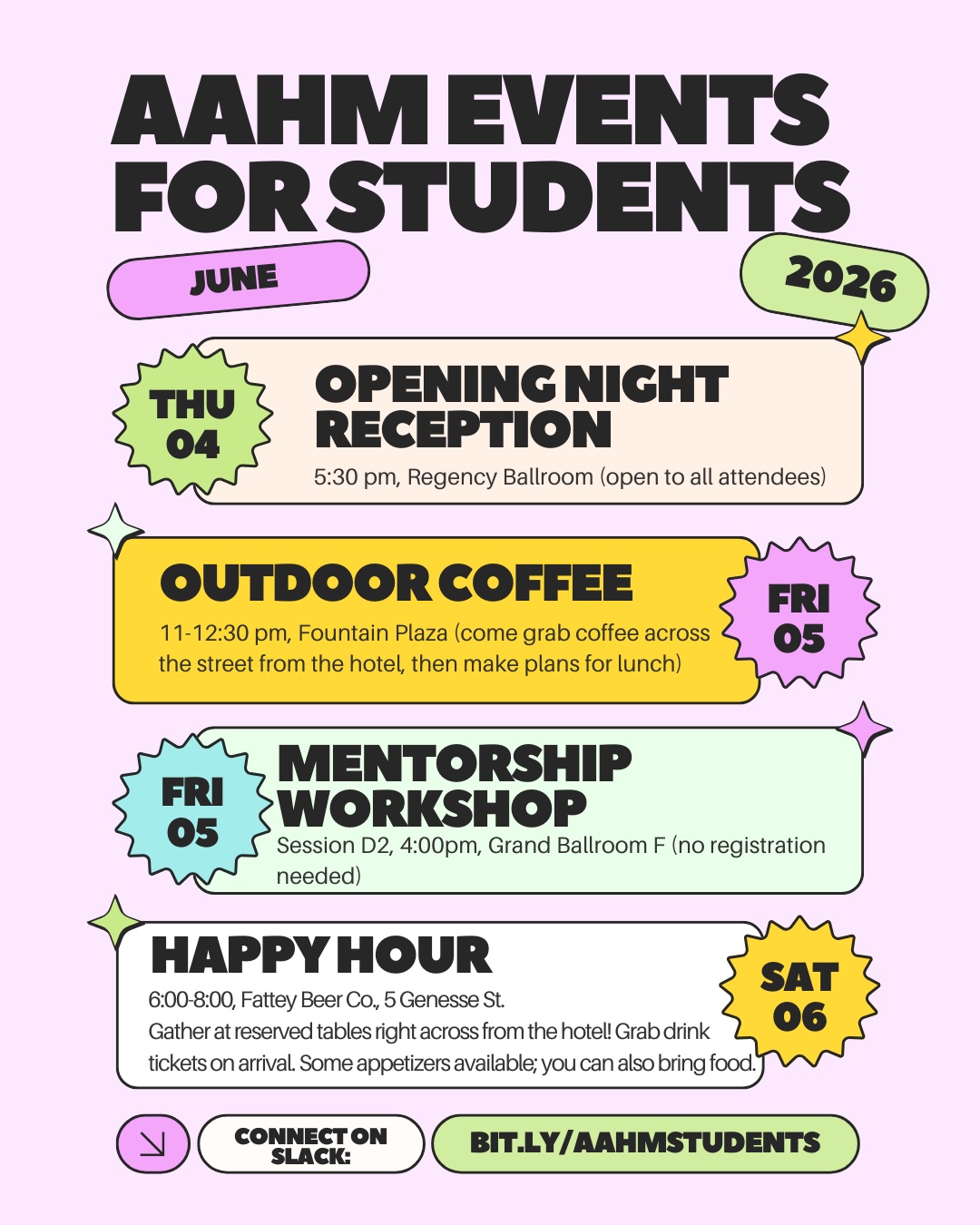
D2. Mentorship Workshop: Insights From Faculty, Staff, and Postdocs for Students
Friday June 5, 2026 4:00pm - 5:15pm EDT
The AAHM Student Affairs Committee is happy to be reprising our mentorship workshop for the third year. In this workshop, students and more established professionals in academia, libraries, archives, and museums will break into small groups to chat about the job search, funding, publishing, and more. We will have prompts on hand, but please bring questions of your own. This is a great opportunity to hear candid advice from people who have been where you are, and to kickstart new relationships in the process.

Chair email: [email protected]

Speakers
JH

Jessica Hester

Johns Hopkins University

Friday June 5, 2026 4:00pm - 5:15pm EDT
Grand Ballroom F Hyatt, Mezzanine Level
 
Saturday, June 6
 

10:15am EDT

E2. Madness, Medicine, and Materiality Across the Atlantic World
Saturday June 6, 2026 10:15am - 11:45am EDT
1. Olivia Weisser, The Dreaded Pox and Household Medicine in Early Modern England ([email protected])
2. Francesca Gibson, Hysterical Conceptions: Madness, Reproduction, and Race in the Early Modern British Atlantic World ([email protected])
3. Evan Ragland, Disease, Pathological Anatomy, and the Question of Causes in Early Modern Europe ([email protected])

Chair email: [email protected]
Moderators
avatar for Jennifer Kosmin

Jennifer Kosmin

Auburn University
Speakers
OW

Olivia Weisser

University of Massachusetts-Boston

FG

Francesca Gibson

PhD Student, University of California, Santa Cruz


ER

Evan Ragland

University of Notre Dame

Saturday June 6, 2026 10:15am - 11:45am EDT
Grand Ballroom F Hyatt, Mezzanine Level

1:00pm EDT

F2. Medical Networks: Patients, Publics, and Markets from the Cold War to Neoliberalism
Saturday June 6, 2026 1:00pm - 2:30pm EDT
1. Eram Alam, In Search of Care: Scenes from the US/Mexico Border ([email protected])
2. Claire Edington, "A War Inside a War: Fighting Drug Addiction During the Decolonization of Vietnam"  ([email protected])
3. Kavita Sivaramakrishnan, From Russia, with Love: The Promise of Indo-Soviet Medical Cooperation and Assistance in Postcolonial India ([email protected])


What does it mean when countries open borders and resources for scientific exchanges and cooperation, care and treatment, and in turn, like today, when these historic moments and ‘openings’ end or close? This panel brings together four papers to explore the mobility and immobility of medical ideas and networks in the 20th-21st century, in the context of the Cold War and post-colonial modernization, and neoliberal projects in Asia, Latin America and Africa. The papers will discuss the pathways of circulation for experts, patients, and the changing aspirations that underlay these partnerships and interactions. Just as medical networks flowed outwards, their founders also addressed internal politics and ideologies, such as interpreting the value of science and socialism; and they were compelled to confront domestic, political rivalries. What did these exchanges represent for hosts in Eastern Europe and the Soviet Union, and what insights does it offer us on ‘Cold War medicine’ as a diverse and fluid, even contradictory project? How were foreign medical research and technological aid understood and justified in the newly decolonized nations, and what vocabularies and discourses were deployed? How do these networks and collaborations with socialist physicians recast 'western' tropes about backward medical 'peripheries' and developed, 'centers,' that were pervasive in aid discourses with the US ?  These medical networks offer us crucial narratives regarding innovation and self-reliance; and how experts, publics, and patients interacted, and also debates regarding emerging medical markets for care. Our panel will look at the 'afterlives' of medical networks in a neoliberal context when markets and consumer choices lead to patients seeking care across borders, such as between Mexico and the US. How do cultures of aid and medical exchange, also translate later through medical expertise that is marketed to patients as tourists. The papers in our panel will productively address these questions, and critically evaluate medical networks and knowledge and care in transit on border crossing ways.  
Moderators
MA

Michitake Aso

SUNY Albany
Speakers
EA

Eram Alam

Harvard University
CE

Claire Edington

University of California, San Diego

KS

Kavita Sivaramakrishnan

Columbia University
Saturday June 6, 2026 1:00pm - 2:30pm EDT
Grand Ballroom F Hyatt, Mezzanine Level

3:45pm EDT

G2. Carceral Sickness in the State of New York
Saturday June 6, 2026 3:45pm - 5:15pm EDT
Scholars like Harriet Washington, Heather Ann Thompson, and Susan Reverby have illuminated the history of substandard healthcare provision in American prisons during the twentieth century. They have identified the many harms endured and resisted by generations of prisoners, their families, and broader communities, harms arising from factors like enduring racism, medical experimentation, malnutrition, overcrowding, inadequate service provision and oversight, and unmet mental health needs. Despite reports and inquiries spanning decades, from Rector’s 1929 survey of medical provision in American prisons to investigations surrounding the 1971 Attica uprising, the carceral system’s health problems have remained deeply entrenched and widespread, especially following the rise of mass incarceration in the 1970s.  

This roundtable discussion will draw connections and comparisons across one hundred years of prisoners’ health experiences in the state of New York, with a particular focus on infectious disease. The research team - three formerly incarcerated scholars and one university-affiliated historian - came together in 2024 to investigate questions of sickness, disability, race, and scientific racism using century-old prison records at the New York State Archives. 
Building from an archival exploration of syphilis treatment during the 1920s at Elmira Reformatory, the Institution of Defective Delinquents at Napanoch, and Sing Sing Prison, the discussion will expand to foreground more recently incarcerated individuals’ experiences facing infectious diseases like HIV, Hepatitis C, and COVID-19. Questions the speakers will address include:
  • How did changing testing and treatment standards for syphilis affect New York prisoners during the 1910s and 1920s?
  • To what extent were/are prisoners coerced into treatment and to what extent could/can they resist?
  • In what ways did/do certain diseases attract moral punishment within prison settings?
  • How might the inclusion of formerly incarcerated scholars in the research and writing process lead to a richer understanding of historical and present-day healthcare challenges within the carceral system?
Chair email: [email protected]

Learning Outcomes
  • Develop a historically informed understanding of sickness and health in the carceral system
  • Develop an understanding of the enduring nature of inadequate healthcare provision in American prisons
  • Learn about research co-production methodology

Moderators
avatar for Richard McKay

Richard McKay

University of Cambridge


Speakers
KK

Kevin Kareem Brooks

Hudson Link for Higher Education in Prison

avatar for Leon ”Struggle” Davis

Leon ”Struggle” Davis

Consultant, Researcher, Hudson Link for Highter Education in Prison
Leon Davis is a community-based researcher, public health student at Columbia University’s Mailman School of Public Health, and educator whose work examines incarceration through the lens of the history of medicine and carceral health. He is a lead researcher with the Carceral Sickness... Read More →
RQ

Reginald Qualls

Independent Scholar, Hudson Link for Higher Education in Prison
Saturday June 6, 2026 3:45pm - 5:15pm EDT
Grand Ballroom F Hyatt, Mezzanine Level
 
Sunday, June 7
 

8:30am EDT

H2. After the Single Use: Toxicity and Risk in Medical Technologies
Sunday June 7, 2026 8:30am - 10:00am EDT
1. Eloïse Richard, Toxic Asepsis: Chemical Sterilization and the Rise of Disposable Medical Devices in the 20th Century ([email protected])
2. Amanda Mahoney, “A non-expendable disposable,”: Nurses, Central Supply, and the Problem of Tubing in U.S. Hospitals, 1915-1965 ([email protected])
3. Sloane Wesloh, Personal health devices, chronic disease, and the consumerization of risk ([email protected])

Chair email: [email protected]
Moderators
JG

Joseph Gabriel

Florida State University
Speakers
ER

Eloïse Richard

University of Geneva

AM

Amanda Mahoney

Case Western Reserve University

avatar for Sloane Wesloh

Sloane Wesloh

PhD candidate, History and Philosophy of Science, University of Pittsburgh

Sunday June 7, 2026 8:30am - 10:00am EDT
Grand Ballroom F Hyatt, Mezzanine Level

10:30am EDT

I2. Expertise Across Medical Boundaries
Sunday June 7, 2026 10:30am - 12:00pm EDT
1. Lucas Richert, "The Physician Is Boss?”: Scope Creep, Status Strain, and the Pharmacist–Physician Divide in American Healthcare ([email protected])
2. Libby O'Neil, Wired Up: Biofeedback Research between Medicine and Counterculture in the 1970s ([email protected])
3. Matthew Soleiman, “Ten Steps from Patient to Person”: Self-Help Activism and the Emergence of the American Chronic Pain Association ([email protected])

Chair email: [email protected]
Moderators
JS

Jonathan Sadowsky

Case Western Reserve University
Speakers
LR

Lucas Richert

University of Wisconsin-Madison

LO

Libby O'Neil

Mississippi State University

MS

Matthew Soleiman

University of California, San Diego

Sunday June 7, 2026 10:30am - 12:00pm EDT
Grand Ballroom F Hyatt, Mezzanine Level
 
2026 AAHM + AAHN Annual Meeting
Register to attend
Share Modal

Share this link via

Or copy link

Filter sessions
Apply filters to sessions.